Wied Ghollieqa
Overview
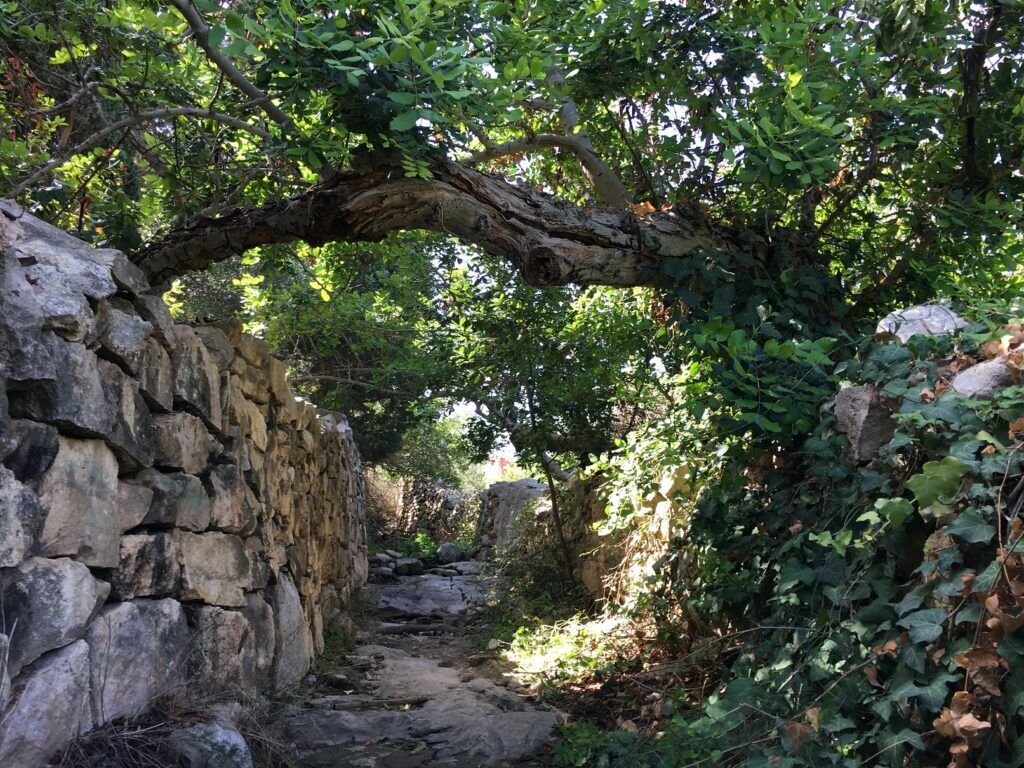
Wied Għollieqa is a small valley located in the north east of Malta next to the University of Malta. It was saved from urban development in the 1980s by local environmental NGOs, local residents and students and an afforestation program was initiated by Nature Trust Malta to rewild the valley.
Much of the valley is now a protected area populated with a large number of trees including the largest population of the endangered national tree in Malta, the Sandarac Gum Tree (‘Siġra tal-Għargħar’ – Tetraclinis articulata).
It provides a vital refuge and nesting area for avifauna like the Sardinian Warbler (‘Bufula Sewda’ – Sylvia melanocephala), Cetti’s Warbler (Bufula tal-Għollieqa, Cettia cetti), Common Swift (‘Rundun’ – Apus apus) as well as mammals like the rare Least Weasel (‘Ballottra’ – Mustela Nivalis).
Archaeological remains have been discovered in the valley including pottery vessels from the first phase of the Bronze Age, a tomb dated to 50AD containing cremation urns, pottery flasks, jars, saucers, lamps, two female skeletons and one male skeleton, a tower,
a cistern and cart ruts.
The site is designated as a Bird Sanctuary, Level 2 Area of Ecological Importance (AEI), Level 1 Site of Scientific Importance, Tree Protection Area and a Special Area of Conservation (SAC).
The nature reserve is managed by Nature Trust Malta with the help of funding from the Environment and Resources Authority (ERA) in accordance to a detailed restoration plan written by ecologist Dr Eman Calleja.
Site Access
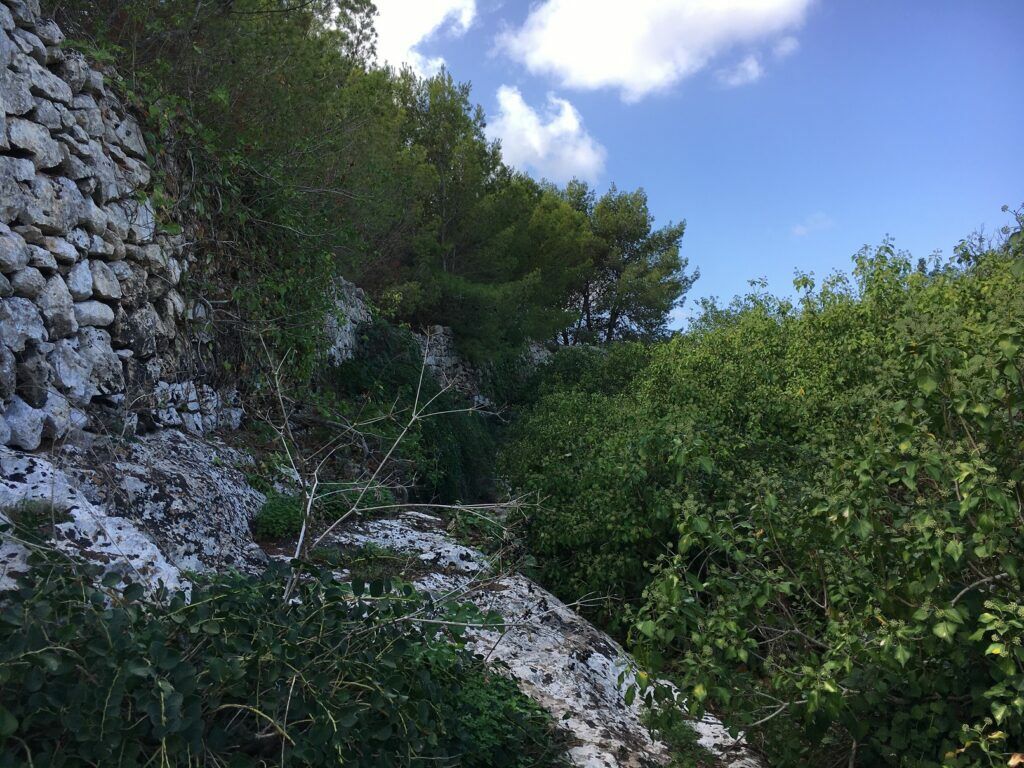
Due to the presence of a fence surrounding the entire nature reserve and private land within the valley, access is restricted to three entrances from University (via car park 1, the Mediterranean Institute and the ring road opposite the engineering department), an open gateway from Kappara, or the emergency route for fire trucks from Vjal Mikiel Anton Vassalli.
History
From historical documents it seems that Wied Għollieqa was not studied much in the past and its first reference is by Briffa & Lanfranco in 1986 where the authors describe a number of fungi present in the valley.
In the 1990s, Wied Ghollieqa however started making national headlines due to the proposal for its amalgamation with the ever expanding University and its subsequent development into a car park, science park and engineering department. This idea led to a num ber of environment groups, mainly Arbor Università, and many students and residents living close by all voicing their opinion against the development.
The first scientific report of the area was drawn up by Arbor Università (1990) where the soil and other physical features of the area, together with vegetation patterns, plans for reforestation and reasons for “saving” Wied Għollieqa were analysed. This report and the commencement of the afforestation project, however, had no effect on the scheduled plans and the car park was being built with the result that many old trees were uprooted, rubble walls bulldozed and fertile soil carted away or dumped.
Finally, in 1991, the Parliamentary Secretary at the time, agreed that there was a basis for Arbor’s proposal to be seriously considered and that the secretariat was evaluating the matter for Wied Għollieqa to become a nature reserve. Eventually, development of the engineering department and science park was shelved and the 1990 afforestation report was revised. In November 1993, legal notice 146 was passed, declaring Wied Għollieqa a Bird Sanctuary as of 1st January 1994.
In 1997, parts of Wied Għollieqa were also declared as a Level 2 Area of Ecological Importance (AEI) and a Level 1 Site of Scientific Importance surrounded by Levels 2 and 3 Buffer Zones according to Government Notice 241 of 1997.
In 1999, the former Environment Protection Department (or EPD, now part of MEPA) gave sole responsibility of the site to Nature Trust (Malta) and in 2000 the Green 2000 Campaign was launched: an ambitious project in which 8,000 trees and shrubs will be planted in the valley throughout the years by members of the public, organisations, etc. The first three trees were planted by the then President of the Republic of Malta, Dr. Guido Demarco, the Prime Minister, Dr. Eddie Fenech Adami, and the Leader of the Opposition, Dr. Alfred Sant.
In 2001, Wied Għollieqa was also designated as a Tree Reserve/Nature Reserve and in 2003 as a Special Area of Conservation.
Ecology
Biologically, Wied Għollieqa is important for a number of species that live in the area, such as the weasel (Mustela nivalis) which is very rare and reported to live in Wied Għollieqa. Other species include a number of fungi that are rare on a local scale or also on a European scale, such as Inonotus indicus which has been recorded for the first time in Europe from Wied Għollieqa itself. Following reforestation, Wied Għollieqa also houses the largest population in the Maltese Islands of the national tree, the sandarac gum tree (Tetraclinis articulata) giving the area a very high conservation value due to the rarity of the tree. The site is also important since a number of trees protected within the Trees Directive are present in the area and a number of protected birds also use the valley as nesting grounds.
Geology & Geomorphology
It is quite likely that Wied Għollieqa is a river valley and was formed due to erosion during the Quaternary pluvial period. Formation due to tectonics is unlikely due to the absence of main geological faults in the area.
The main rock outcrop is Lower Coralline Limestone but is only exposed in parts of the valley where garigue and steppe are evident.
Avifauna
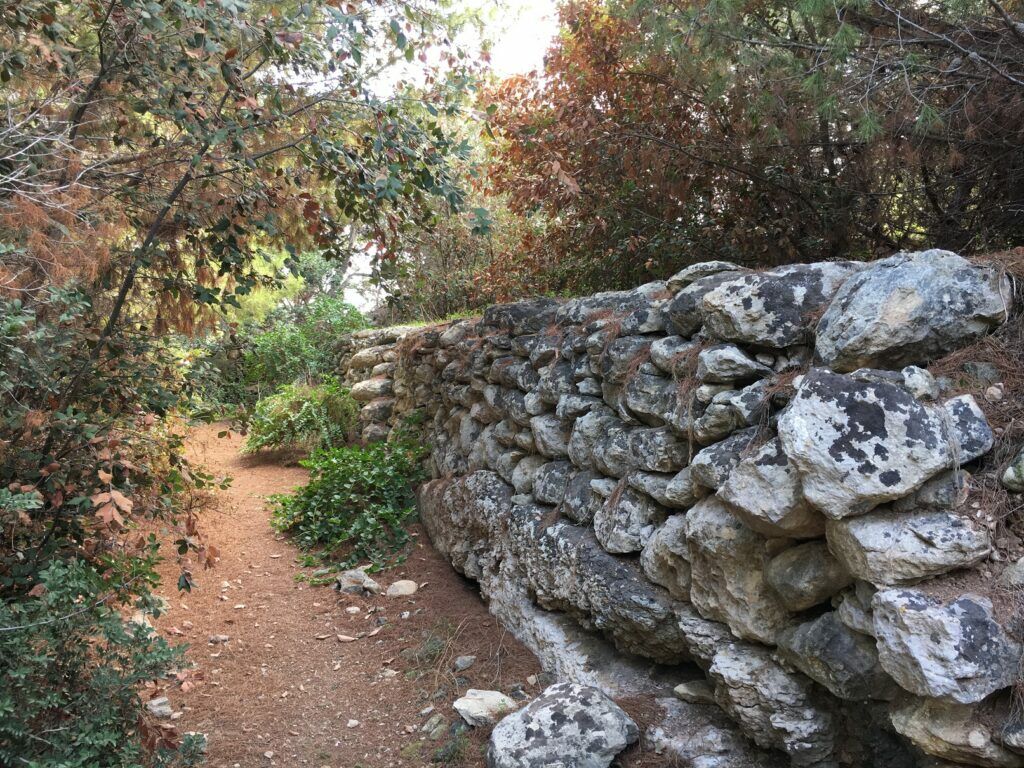
Being the only patch of green land surrounded by a highly urbanised area in Malta, Wied Għollieqa is in fact, a sanctuary for many migrating species as well as breeding species of birds. It provides a variety of habitats such as a narrow riparian community and maquis community. The latter contains shrubs and trees such as Lentisk, Carob, Buckthorn and Aleppo Pine, while the valley bed is full of Bramble, giving the valley its name. Amongst the species that benefit from Wied Għollieqa are the Common Swift, which glide here to feast on insects; several warblers such as the Sardinian which, builds its nest in denser shrubs; and other enjoyable species such as the Hoopoe, Golden Oriole and Grey Wagtail. The valley is definitely worth a bird watching visit and you will be surprised with the number of birds you can see so close to home!
Common Swift (Apus apus – Rundun)
The Common Swift is one of the species that is increasing as a Maltese breeding bird. It breeds in buildings at several localities close to Wied Għollieqa, such as Mater Dei, Msida and Gzira. The valley, found in between, thus acts as an important foraging site for swifts. They can often be spotted flying low over the trees feasting on small insects. Swifts are very agile birds and spend most of their life on the wing. They have narrow-curved wings which give a characteristic flight, recognised as fast-paced with frequent changes in flight course. It is not always a frenzied flight; they also have long glides on a calm breeze. This behaviour together with their dark colour, and contrasting pale patch on the throat are the best identification features. Their call is also quite unique. It sounds like a shrill ringing-like scream, creating a special atmosphere in the otherwise rather quite summer months. The Pallid Swift, which also breeds in the area, is very similar to the Common Swift but it is highly difficult to distinguish even with experience.
Sardinian Warbler (Sylvia melanocephala – Bufula Sewda)
In spring one can hear the chattering song of the Sardinian Warbler, and throughout the rest of the year its loud rattling call fills the valley. These small birds have a black head, or grey in case of females and distinct eyes with a striking red-ring around them. When it flies, note its black tail edged with a white pattern. Sardinian Warblers are one of the few breeding birds that are very common in the Maltese Islands and this applies to Wied Għollieqa as well. The mixture of tall mature trees and lower bushes, many having berries and forming thick undergrowth, are an ideal habitat for the species. Bird ringing carried out by licensed ringers in the valley has shown that Sardinian Warblers are present in good densities. Birds from neighbouring gardens are also likely to make use of the rich food supply. In spring the birds construct cup-shaped nests in the dense shrubs and lay around four eggs. When these hatch the parents catch and feed insects to their young in a non-stop manner, and also have to scold away any cats which can pose a threat.
Cetti’s Warbler (Cettia cetti – Bufula tal-Għollieqa)
The Cetti’s Warbler only became a breeding resident in Malta in the 1960’s but since then it has spread to most vegetated valleys and dense maquis areas. That being said, Wied Għollieqa has the perfect habitat, especially with its thickets of bramble on the valley bed. Around three pairs appear to be breeding in the valley. Cetti’s warblers are identified by their small size and chestnut-brown colour. Given their size, they are difficult to spot. However, their explosive song makes up for their skulking behaviour. It is short and sudden but very intensive; something along the lines of “chet..chet..chippi, chippi, chippi…chippi”. Once heard a few times, it is unmistakable. In autumn young males’ songs vary whilst they practice until they perfect it, in the hope of attracting a female. Nests are built in the shelter of dense vegetation, trees and even Great Reed. Eggs, of which 4 are laid, are a brick-red colour, hidden well within a deep-cupped nest. The eggs are incubated for around 17 days and the hatchlings take around 14 days of intensive feeding by the parents before they leave the nest. After a few days with the parents the young birds have to fend for themselves and will in time leave the area to find a territory of their own. In fact, bird-ringing research revealed that a male that spent some time at Simar Nature Reserve in Xemxija, moved to Wied Ghollieqa where it is now breeding. It would certainly be worth listening out for the Cetti’s Warbler on your next visit to Wied Għollieqa!
Robin (Erithacus rubecula – Pitirross)
Everyone knows the Robin! It is one of our more loved species of birds, and in turn the Robins really like Wied Ghollieqa where they can be found in good numbers in the winter months. Some even stay on in summer in the lush parts of the valley, but so far breeding has only been confirmed once and on the island of Gozo. When they arrive in autumn, the valley is alive with their beautiful song and clicking calls, with some perching on open branches to show off their rather bright rusty-red breast. The Robin might be seen as cute but it is very territorial towards other Robins and will chase off any intruders ferociously. In turn they often feed on the ground in search of insects, small worms and snails. Unfortunately in the past Robins were locally caught illegally in cage traps, something also carried out in the valley, but luckily this practice has been phased out. Today Robins are there to be enjoyed by everyone!
Blue Rock Thrush (Monticola solitarius – Merill)
This beautiful bird known for its bright blue plumage and song echoing between coastal cliffs might not be a species we would associate with Wied Għollieqa. However, a few sightings have occurred around Wied Għollieqa with birds seen perching on surrounding buildings. These might typically be younger birds dispersing in the late summer and autumn from the areas where they fledged. However one autumn even an adult male was to be seen. Young birds might not be as striking as adult male birds but are browner and feathers show some scaling on closer quarters. So while the valley might not be the most likely place to go searching for the Maltese National bird, do keep an eye out for them.
Spotted Flycatcher (Muscicapa striata – Żanżarell tat-tikki)
The Spotted Flycatcher might not have the most outstanding plumage because it is mostly grey and as the name indicates, with some darker streaking. It makes up for a dull appearance with its acrobatic antics in flight which allow it to catch flies and mosquitos. It is known for returning to the same perch as the one from which it launched its aerial pursuit. The Spotted Flycatcher is a common spring migrant often occurring in large numbers, or “falls”, when all valleys and gardens in Malta will have many busily feeding individuals. They also occur during autumn migration, albeit to a smaller number. However, the Spotted Flycatcher is not just migratory. In recent decades, a few pairs have bred in wooded valleys, gardens and cemeteries. So far no breeding has been confirmed in Wied Għollieqa or the adjacent University campus. Nevertheless, the ideal habitat is present with mature Aleppo pine and Cypress trees and it might only be a matter of time before a seemingly growing population of Spotted Flycatchers colonise the area!
Grey Wagtail (Motacilla cinerea – Zakak tad-dell)
One of the more elegant birds to visit Wied Għollieqa occasionally is the Grey Wagtail. It’s a bird which likes running water and has therefore rather restricted available habitat in Malta, except maybe in the winter months when valleys have small streams of water. Then in can be seen feeding on their edges as is the case with Wied Għollieqa where its favourite spot is the dam that holds some water in winter. It usually flies away quickly on an observer’s approach showing off its long tail with white borders and calling its characteristic “zi-zi” call. Unlike its similar species, the White Wagtail, it has some yellow feathers especially on the vent in addition to the grey, white and black plumage. Males in spring plumage acquire an even fancier attire with an all bright yellow belly and a black bib. This plumage would be unusual to see in Malta since it is mostly a winter visitor when it escapes frozen streams in Northern Europe. Nevertheless the Grey Wagtail has bred in recent years, the first documented record being further up the valley system of Wied Għollieqa, next to Mater Dei, where there was some water flowing into late spring. Surely if the right habitat was created in the valley the Grey Wagtail could be a great additional breeding species in the nature reserve.
Golden oriole (Oriolus oriolus – Tajra Safra)
A flash of yellow passing through the tall trees in late April and early May, followed by fluting calls are the sign that one of our more beautiful migratory birds are feeding in the valley. Golden Orioles often occur together,  concentrating where there is a source of food, like Loquat fruit. In their European breeding grounds they are more frequently heard than seen. In Malta we are perhaps lucky to be able to enjoy views of these birds when they come out of dense canopies to feed in more open areas. The adult males are a stunning yellow with black wings. The females and young birds are more greenish, albeit still pretty. Unfortunately, this plumage makes them attractive to illegal hunting both locally and in other migration hotspots, but Wied Għollieqa offers a safe haven on their temporary stop over on the Maltese Islands.
Collared Dove (Streptopelia decaocto – Gamiema tal-Kullar)
From being a scarce visitor, in a decade the Collared Dove has become a common breeding resident in parts of Malta and Gozo where it is found in gardens and areas with big trees. It first colonised Santa Marija estate in Mellieħa, perhaps because here it was fairly safe from hunting, but has slowly spread. It now can also be seen around Wied Għollieqa, perhaps not breeding in the valley itself yet, but in the surrounding gardens in Kappara and even in the University Campus. It is one of the larger species of birds that occur in the valley and is only slightly smaller than a Feral pigeon. It also has a more clipping flight and only occurs in a pale buff-grey plumage. The Turtle Dove, which is quite similar but has rusty-orange on parts of the wing, occurs in the nature reserve in spring and autumn migration. Unfortunately it is one of the main legal quarries of Maltese hunters and released from this pressure, would breed too. Both species of dove have a pleasant call, the Collared dove’s being more cooing than the purring call of the Turtle Dove.
Goldcrest (Regulus regulus – Bufula tal-Qamar)
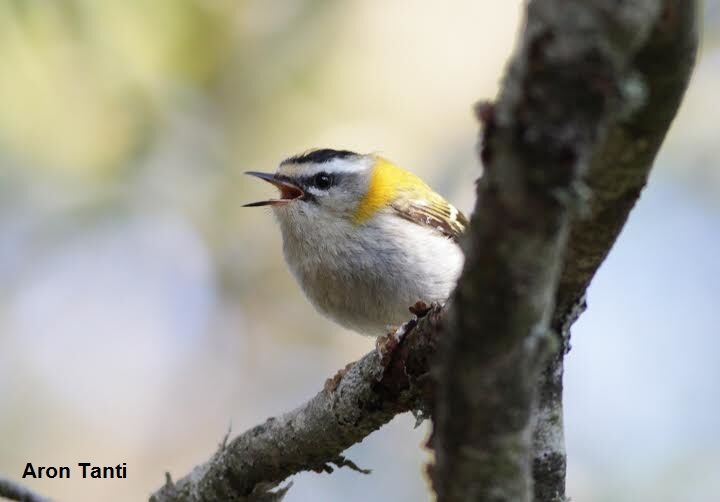
These birds are tiny and in fact are the smallest birds in Europe! More often than not you first notice them from their high pitched calls, something like “tsii-tsii-tsii-tsii”. They may be difficult to spot in the canopy, but you may get a chance when they hover around the trees on quickly beating wings, or feed on the outermost branches. They are very active and rarely stay in one place. Wied Għollieqa is especially attractive to this species due to presence of Aleppo pine, since Goldcrests like conifers. Moreover, due to the mixture of other trees the very similar Firecrest can be found as well. The latter is told apart due to the striking white stripe above the eye. Crests, as they are collectively known, stay in Malta from late autumn to late winter escaping the cold temperatures further north. That said, they are not annual visitors and some winters go by with barely any sightings while in other years they are rather common. This probably has to do with the harshness of winter in mainland Europe.
Wood Warbler (Phylloscopus sibilatrix – Vjolin Ħadrani)
The Wood Warbler, like the Goldcrest seems to like areas with Aleppo pine trees on migration stop overs. Also like the crests, it flits quickly through the canopies in search of small insects, sometimes taking them on the wing. It is slightly larger than the crests but only by a bit. The Wood Warbler is yet another species with bright plumage, greenish above, with a yellow breast offset by a pure white belly. Quite pretty if you manage to see it for more than a few seconds! It is one of many migratory warblers that stop over for a short while to feed and rest on their long journeys between Africa and Europe. For them it is vital to find the correct habitat to boost their energy reserves after having crossed the Sahara desert! There are a few more species that resemble the Wood Warbler and do occur frequently such as the Willow warbler and the Chiffchaff. The latter is not a long distance migrant like the Wood Warbler but remains in the Mediterranean, including Wied Għollieqa, in the winter. As soon as the Chiffchaffs leave in around March, the Willow and Wood Warblers start arriving from Africa, a truly awe-inspiring natural cycle of migration! For most of the year, with the exception of summer, one can thus look out for these cute birds!
Hoopoe (Upupa epops – Daqquqa tat-toppu)
The sighting of a Hoopoe as it flies off in front of you and shows off its black and white wing pattern is always an amazing experience. This can occur at Wied Għollieqa, mostly during spring time. The trees planted on the valley sides with the right amount of open ground in between offer a great habitat for this beautiful migrant. You may be lucky enough to spot it before it flies off and enjoy it probing the ground with its long curved beak or even see it fan its long crest feathers! Even the flight of the Hoopoe is fascinating, almost elegant as a butterfly. You can also spot the Hoopoe on the adjacent University Campus. So keep an eye out, it will make your day! The Hoopoe, like some of the other species mentioned is a trans-Saharan migrant, and would be returning to Europe from across the Sahara desert in Spring. After it breeds it heads back, on both journeys possibly stopping in Malta for a short break. These long, arduous journeys are a real natural marvel and in Malta and Wied Għollieqa we are fortunate to observe some of the millions of migrating birds crossing the Mediterranean.
Black redstart (Phoenicurus ochruros – Fjamma sewda)
Known for its rusty-red tail, which it shows off as it takes flight or lands, the Black Redstart is easy to find in urban areas during the winter months. Its clicking call and harsh rattling song can be heard from rooftops, especially on quiet evenings. Like the Robin, intruding birds mean trouble and close encounters between each other leads to frenzied chasing. This makes them all the more amusing to watch as they fly calling over the valley. Female and young birds have a rather dull plumage apart from the striking tail. This is not the case for the adult males, which have a truly beautiful plumage. The black body feathers contrast with the red tail and white patch on the wings. You should watch out for this bird on your next visit in winter!
Above truly only a few of the species that you can encounter in Wied Għollieqa were described, a mixture of common breeding birds as well migrants. Birdwatching is full of surprises and Wied Għollieqa has proved to give some special treats to its visitors! Remember to be careful not to disturb any of the birds you see especially scarce ones, tired migrants and most of all those that might have a nest close by. We hope this description gave you insight on some of the more likely birds you can see in the valley, and inspire you to take a visit of your own!
Contribution to Avifauna Martin Austad and Francesca Bajada
Literature
Wied Ghollieqa features in a fair amount of literature both from the organisations that have managed it and also in two dissertations carried out as part of the B.Sc. (Hons) degree at the University of Malta:
Reports
Arbor. (1992). Report on Wied Għollieqa including proposed afforestation. Valletta, Malta: Arbor. 34pp + 6 maps.
Arbor Università. (1990). Report on Wied Għollieqa including proposed afforestation. Valletta, Malta: Arbor Università. 20pp + 2 maps.
Grech, C.F. (1993). Pjan ta’ saġġir għar-riżerva masġara li hi proposta għal Wied Għollieqa, għas-sena masġara 1993-1994. Msida, Malta: Università ta’ Malta. 10pp.
Management Plans
Nature Trust (Malta) [NTM]. (1999). Management Plan for Wied Għollieqa 1999-2004. Msida, Malta: Nature Trust (Malta).
Nature Trust (Malta) [NTM]. (2004). Management Plan for Wied Għollieqa l/o San Gwann/Msida 2004-2009. Msida, Malta: Nature Trust (Malta).
Nature Trust (Malta) Publications
Attard, V. (ed.). (2005). Wied Għollieqa. (Archipelago Series: Vol. 1, Issue 7). Valletta, Malta: Nature Trust (Malta).
Dissertations
Calleja, E.J. (1995). An investigation of the vegetation of Wied Għollieqa (Malta) with a plan for its restoration as a protected area. Unpublished B.Sc. (Hons.) Dissertation. Malta: Department of Biology, Faculty of Science, University of Malta.
Engerer, Z.C. (2010). A vegetational investigation of Wied Għollieqa. Unpublished B.Sc. (Hons.) Dissertation. Malta: Department of Biology, Faculty of Science, University of Malta.